
CRESTSTONE
  • HOME
  • ABOUT
  • SERVICES
    • BUSINESS
    • PERSONAL
  • RESOURCES
  • CONTACT
  • IPC Wealth Login
  • Click to open the search input field Click to open the search input field Search
  • Menu Menu

    Corporate Life Insurance Planning

    September 4, 2025/in blog, business owners, Insurance, life insurance, Professional Corporations/by CRESTSTONE Wealth

    Corporate Life Insurance Planning: Protect, Reward, and Plan for the Future

    Running a business in often means wearing multiple hats—owner, leader, and long-term planner. But have you ever thought about what happens if you or a key person in your company passes away unexpectedly? Or how you might use your corporation to support retirement, reward top talent, or prepare for taxes when transitioning ownership?

    Corporate life insurance is one of the most flexible and underused tools available to business owners. It helps protect your company, reduce taxes, and build lasting value—both during your working years and when it’s time to pass the business on.

    Let’s look at how business owners are using corporate-owned life insurance to protect their companies and their families while preparing for the future.
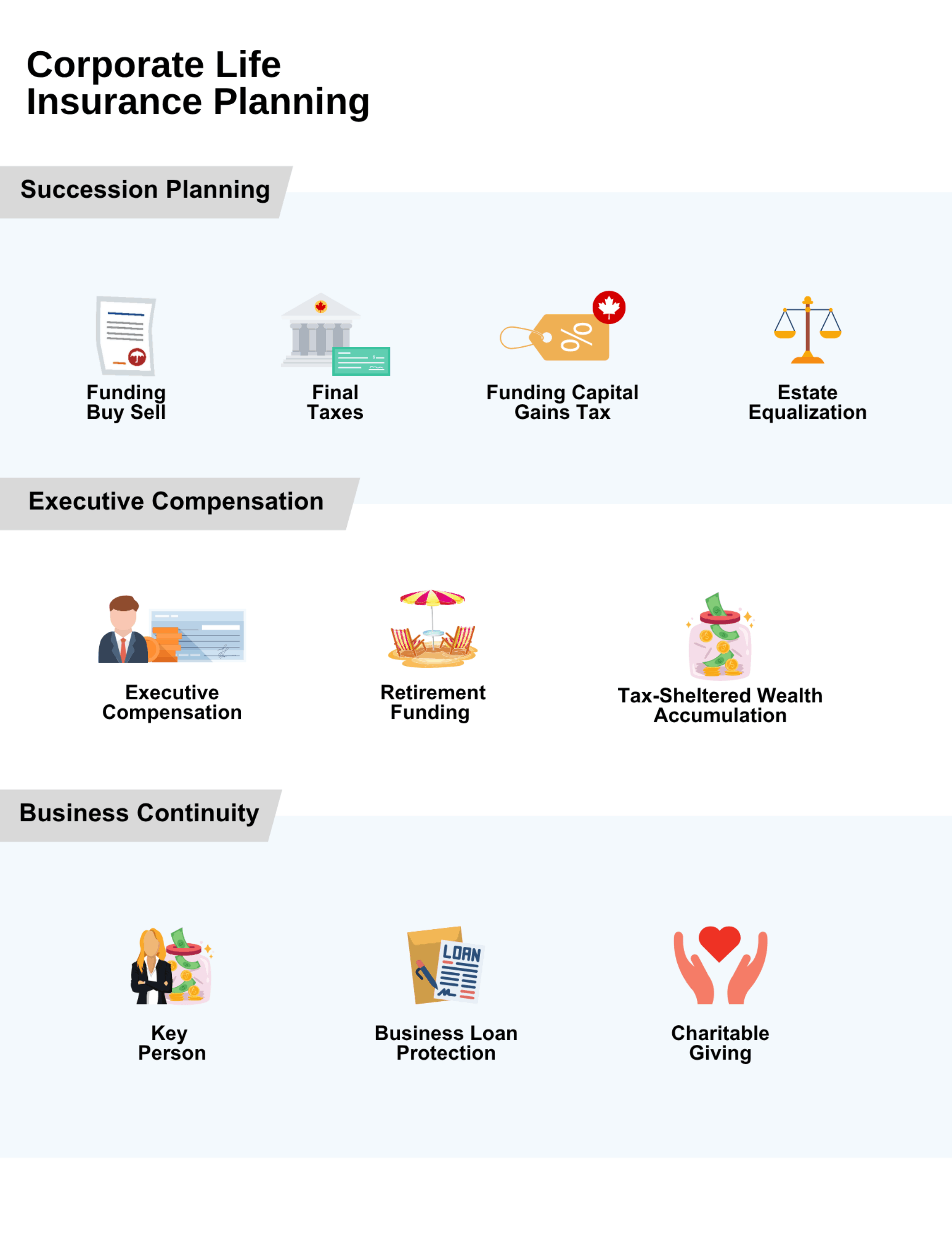
    brandableContent

    Succession Planning: Make Transitions Smooth and Tax-Smart

    For many business owners, their company is one of their largest assets. But passing it on—whether to family or a partner—comes with major financial challenges. Life insurance can help.

    Funding a Buy-Sell Agreement

    If you have a business partner, a buy-sell agreement ensures that if one of you passes away, the other can buy the shares from the deceased’s estate. The problem? That buyout requires cash—often hundreds of thousands, if not millions. Life insurance is a cost-effective way to fund that agreement, so ownership stays in the right hands without putting a strain on the business or the family.

    Covering Final Taxes and Capital Gains

    When a business owner dies, the Canada Revenue Agency treats it as if they sold their shares—even if they didn’t. This “deemed disposition” creates a tax bill that can surprise even the most prepared families. Life insurance provides a tax-free lump sum that the corporation can use to cover this cost, helping preserve the value of the business and avoid selling off assets under pressure.

    Estate Equalization

    If you plan to leave the business to one child but want to treat your other children fairly, life insurance can help. The business goes to the child who’s involved, while other beneficiaries receive the life insurance proceeds. It’s a clean, tax-efficient way to avoid family conflict and keep the business whole.

    Executive Compensation: Attract and Retain Top Talent

    In a competitive hiring environment, offering the right benefits can make all the difference. Life insurance isn’t just about protection—it can be a powerful way to reward and retain your most valuable people.

    Executive Compensation Strategies

    Life insurance can be part of a compensation package that rewards top performers, especially those who are key to the company’s success. Whether structured as a bonus plan or part of a long-term incentive, this can be a powerful way to align goals and build loyalty.

    Retirement Funding

    Permanent life insurance policies (like whole life or universal life) build cash value over time. That value grows tax-deferred and can be accessed through policy loans or collateralized lending. Business owners and executives often use this as an additional retirement income stream, especially if they’ve already maxed out RRSP or TFSA contributions.

    Tax-Sheltered Wealth Accumulation

    The cash value inside a permanent life insurance policy grows on a tax-deferred basis. When a corporation owns the policy, this growth can be especially strategic. It allows the business to use surplus cash to build value in a tax-efficient way, diversify beyond traditional investments, and potentially access funds later with fewer tax consequences. This approach is particularly useful for businesses with retained earnings that would otherwise be subject to higher corporate tax rates.

    Business Continuity: Protect What You’ve Built

    An unexpected death can do more than cause emotional pain—it can disrupt operations, shake client confidence, and even put the business at risk. Insurance helps ensure your company can keep going.

    Key Person Protection

    If you or someone else is essential to the day-to-day success of your business, losing that person could be a major financial blow. A life insurance policy on that individual can help the business recover, cover short-term losses, and fund the search for a replacement.

    Business Loan Protection

    Many lenders require insurance on owners or key executives as a condition of financing. If that person passes away, life insurance ensures the loan is paid off, protecting both the lender and the company’s assets. It can also unlock better lending terms and help avoid personal guarantees.

    Charitable Giving Through the Corporation

    For business owners looking to give back, corporate life insurance can also be used to support charitable causes. The business can own a policy and name a charity as the beneficiary—creating a lasting impact while offering potential tax benefits.

    Bringing It All Together

    Corporate life insurance isn’t just about “what if”—it’s about building a stronger, more resilient business and unlocking smart ways to manage wealth inside your company. Whether you’re focused on succession, rewarding your team, or protecting operations, insurance can help you take action today that pays off for years to come.

    If you haven’t reviewed your corporate insurance strategy recently, now’s a great time to take a fresh look.

    Disclaimer: This article is for informational purposes only and does not constitute financial, legal, or tax advice. Always consult a qualified professional regarding your specific situation. We are not responsible for any actions taken based on this content.

    Share this entry
    • Share on Facebook
    • Share on X
    • Share on WhatsApp
    • Share on LinkedIn
    • Share by Mail
    https://creststonewealth.com/wp-content/uploads/2025/09/Corporate-Life-Insurance-Planning-FI.png 700 1200 CRESTSTONE Wealth https://creststonewealth.com/wp-content/uploads/2021/05/creststone-logo-550.png CRESTSTONE Wealth2025-09-04 06:25:352025-09-04 06:26:03Corporate Life Insurance Planning

    Search Blog Posts

    Search Search

    Newsletter

    Categories

    • 2021
    • 2022
    • 2022 Only
    • 2023
    • 2024
    • 2025
    • 2026
    • Accountants
    • Article
    • blog
    • Budget
    • Business Owners
    • business owners
    • Buy Sell
    • Center of Influences
    • Coronavirus
    • Coronavirus – Associates
    • Coronavirus – Practice Owners
    • Coronavirus – Students
    • corporate
    • Debt
    • dental benefits
    • disability
    • disability insurance
    • Estate Planning
    • Family
    • farmers
    • financial advice
    • financial planning
    • Government Budget
    • Group Benefits
    • health benefits
    • incorporated professionals
    • Individuals
    • Insurance
    • Investment
    • life insurance
    • mortgage
    • pension plan
    • Personal
    • personal finances
    • Professional Corporations
    • Professionals
    • RDSP
    • Registered Education Savings Plan
    • Retirees
    • Retirement
    • RRSP
    • tax
    • Tax Free Savings Account

    Tags

    beneficiary business business owners business succession children debt estate estate planning families funeral expenses individuals key person Life Insurance marital status Mortgage retirement smoking tax

    NEWS + SUPPORT

    Keep up to date with the latest news and helpful websites that share important information related to your business and personal financial needs.

    resources

    Federal Budget 2026: What the New Federal Measures Could Mean for Your Money

    November 10, 2026
    Budget 2026 proposes new affordability, housing, benefit, and business investment measures. From fuel tax relief and a groceries benefit supplement to an “RRSP for life” consultation and the Productivity Mega Deduction, here is a plain-language overview of what the November 5, 2026 budget could mean for Canadians’ money.
    Read more
    https://creststonewealth.com/wp-content/uploads/2026/11/federal-budget-2026-what-it-could-mean-featured.png 1080 1920 CRESTSTONE Wealth https://creststonewealth.com/wp-content/uploads/2021/05/creststone-logo-550.png CRESTSTONE Wealth2026-11-10 14:33:182026-11-10 14:33:59Federal Budget 2026: What the New Federal Measures Could Mean for Your Money

    The RDSP: A Long-Term Savings Tool Canadian Families and Individuals Should Know About

    September 2, 2026
    The federal government has contributed $5.1 billion in grants and $2.1 billion in bonds to Registered Disability Savings Plans since 2008 — yet only 23% of eligible Canadian children aged 0 to 18 have one. Here's how the RDSP works, how much the government match can add each year, why starting early matters, and what the latest 2024 data reveals about the families already benefiting.
    Read more
    https://creststonewealth.com/wp-content/uploads/2026/09/The-RDSP-A-Long-Term-Savings-Tool-Canadian-Families-and-Individuals-Should-Know-About.png 700 1200 CRESTSTONE Wealth https://creststonewealth.com/wp-content/uploads/2021/05/creststone-logo-550.png CRESTSTONE Wealth2026-09-02 21:55:002026-09-02 21:55:18The RDSP: A Long-Term Savings Tool Canadian Families and Individuals Should Know About

    Redesigning Group Benefits: Balancing Cost and Employee Value

    August 8, 2026
    As benefits advisors, we see employers struggling to balance rising costs with employee expectations for flexibility and support. This article explores what employees value most, the risks of cutting coverage, and how data-driven strategies can help organizations redesign plans that deliver both cost control and employee satisfaction.
    Read more
    https://creststonewealth.com/wp-content/uploads/2026/08/Redesigning-Group-Benefits-Balancing-Cost-and-Employee-Value.png 700 1200 CRESTSTONE Wealth https://creststonewealth.com/wp-content/uploads/2021/05/creststone-logo-550.png CRESTSTONE Wealth2026-08-08 08:00:382026-08-08 08:01:08Redesigning Group Benefits: Balancing Cost and Employee Value

    Surrey Office

    604-596-7188
    info@creststonewealth.com

    210 – 5455 152nd St
    Surrey, BC
    V3S 5A5

    KELOWNA OFFICE

    250-860-8389
    info@creststonewealth.com

    1100-1631 Dickson Ave
    Kelowna, BC
    V1Y 0B5

    ABOUT

    Creststone Wealth is a financial planning, investing + insurance firm located in British Columbia, serving clients across Canada.

    NEWSLETTER

    OUR DEALER

    IPC Wealth logo

    Insurance products, including segregated fund policies, are offered through Creststone Wealth by Financial Advisors Stephen Cameron, Noreen G. Winzoski, Rochelle Bates, Terry Sorensen, Bharpur Singh Gill and Lise Winzoski, and Financial Advisors Stephen Cameron, Noreen G. Winzoski, Rochelle Bates, Bharpur Singh Gill and Lise Winzoski offer mutual funds through IPC Wealth Inc. IPC Wealth Inc. is a member of CIRO and the Canadian Investor Protection Fund.

    IPC Wealth and design are trademarks of Investment Planning Counsel Inc. and used under license by IPC Wealth Inc.

    For the IPC Wealth privacy policy, click here.

    Make your investment decisions wisely. Important information about mutual funds is found in the Fund Facts document. Please read this carefully before investing. Commissions, trailing commissions, management fees and expenses all may be associated with mutual fund investments. Mutual funds are not guaranteed, their values change frequently and past performance may not be repeated. Unit values and investment returns will fluctuate.

    ©2021 Financial Tech Tools Inc. | Privacy Statement and Terms of Use
      Link to: Helping Employees Get the Most Out of Their Health Benefits Link to: Helping Employees Get the Most Out of Their Health Benefits Helping Employees Get the Most Out of Their Health Benefits Link to: Leaving Your Employer – Should You Take Your Pension? Link to: Leaving Your Employer – Should You Take Your Pension? Leaving Your Employer – Should You Take Your Pension?
      Scroll to top Scroll to top Scroll to top