
CRESTSTONE
  • HOME
  • ABOUT
  • SERVICES
    • BUSINESS
    • PERSONAL
  • RESOURCES
  • CONTACT
  • IPC Wealth Login
  • Click to open the search input field Click to open the search input field Search
  • Menu Menu

    TFSA versus RRSP – What you need to know to make the most of them in 2022
    February 1, 2022/in 2022, blog, RRSP, Tax Free Savings Account/by CRESTSTONE Wealth

    TFSA versus RRSP – What you need to know to make the most of them in 2022
    TFSAs and RRSPs can be significant savings vehicles. To help you understand their differences, we have put together this article to compare:

    • TFSA versus RRSP – Differences in deposits

    • TFSA versus RRSP – Differences in withdrawals

    TFSA versus RRSP – Difference in deposits

    There are four main areas to focus on when comparing differences in deposits for 2022:

    1. Contribution Room

    2. Carry Forward

    3. Contributions and Tax Deductibility

    4. Tax Treatment of Growth

    How much contribution room do I have?

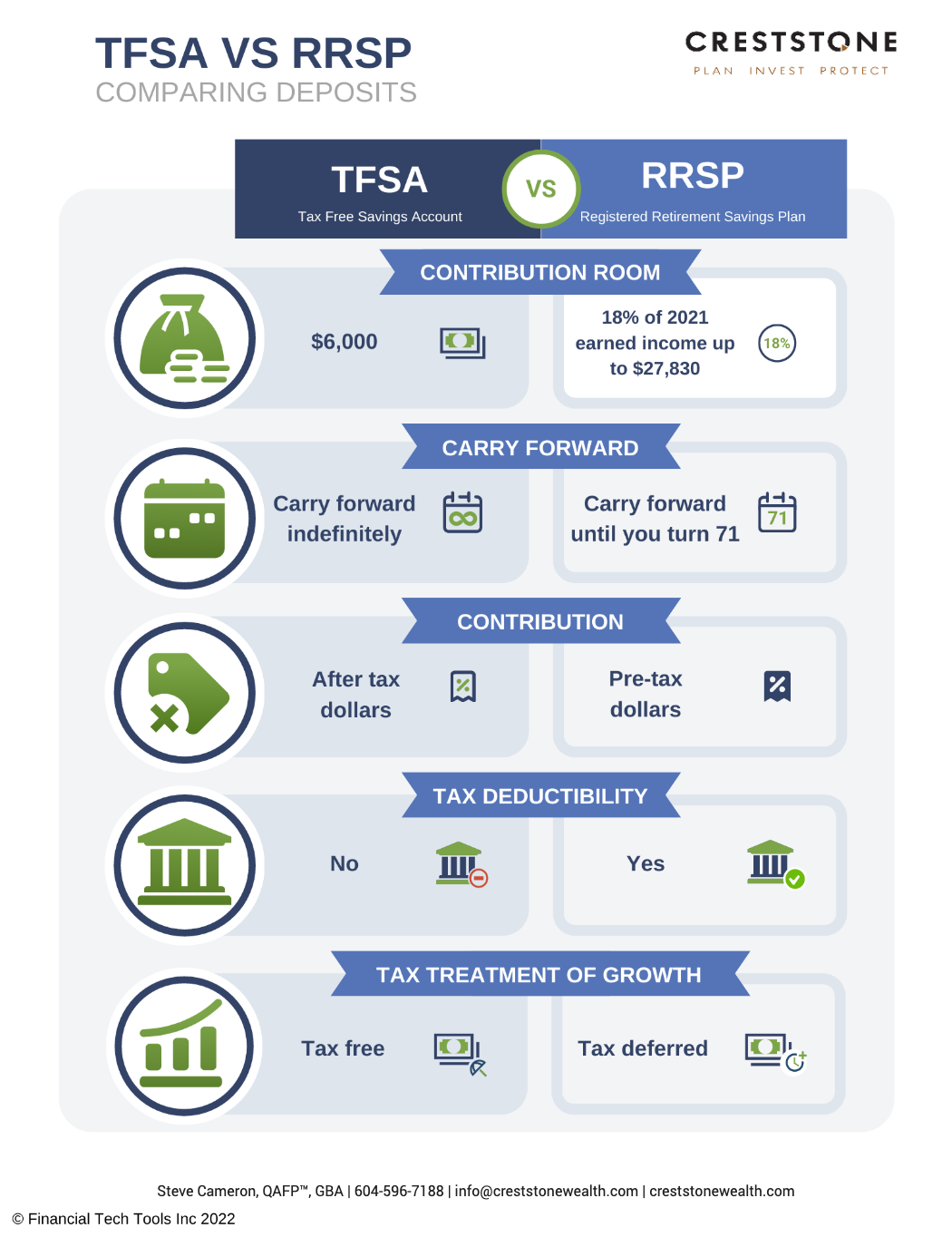
    If you have never opened a TFSA before, you can contribute up to $81,500 today. This table outlines the contribution amount you are allowed each year since TFSAs were created, including this year:

    For RRSPs, the contribution limit is always 18% of your previous year’s pre-tax earnings to a maximum of $29,210. For example, if you earned $60,000 in 2021 then your contribution limit for 2022 would be $10,800 (18% x $60,000). If you earned $200,000, your contribution limit would be capped at the maximum of $29,210.

    How much contribution room can I carry forward?

    If you choose not to contribute to your TFSA at all one year or do not contribute the maximum amount in a year, you can indefinitely carry forward your unused contribution room. The only restrictions on this are that you must be a Canadian resident, older than 18, and have a valid social insurance number. In addition, if you make a withdrawal, the amount you withdrew is added to your annual contribution room for the following calendar year.

    For an RRSP, you can carry forward your unused contribution room until the age of 71. When you turn 71, you must convert your RRSP into an RRIF. If you make a withdrawal from your RRSP, you do not open up any additional contribution room.

    Contributions and Tax Deductibility

    Your TFSA contributions are not tax-deductible and are made with after-tax dollars. Your RRSP contributions are tax-deductible and are made with pre-tax dollars.

    Tax Treatment of Growth

    One of the reasons it is essential to make both RRSP and TFSA contributions is that investment value growth is treated differently.

    A TFSA is more suitable for short-term objectives like saving for a house down payment or a vacation because the investment value growth is tax-free. In addition, when you make a withdrawal from your TFSA, you will not have to pay income tax on the amount withdrawn.

    The growth in an RRSP is tax-deferred, meaning you will not pay any taxes on your RRSP gains until you withdraw money from your future RRIF account; the account you convert your RRSP into at age 71. As a result, RRSPs are better suited for long-term objectives, like retirement. In addition, since you will have a lower income in retirement than when you are working, you will be in a lower tax bracket and not pay much tax on your RRIF income.

    TFSA versus RRSP – Differences in withdrawals

    There are four main areas to focus on when comparing differences in withdrawal for 2022:

    1. Conversion Requirements

    2. Tax Treatment

    3. Government Benefits

    4. Contribution Room

    Conversion Requirements

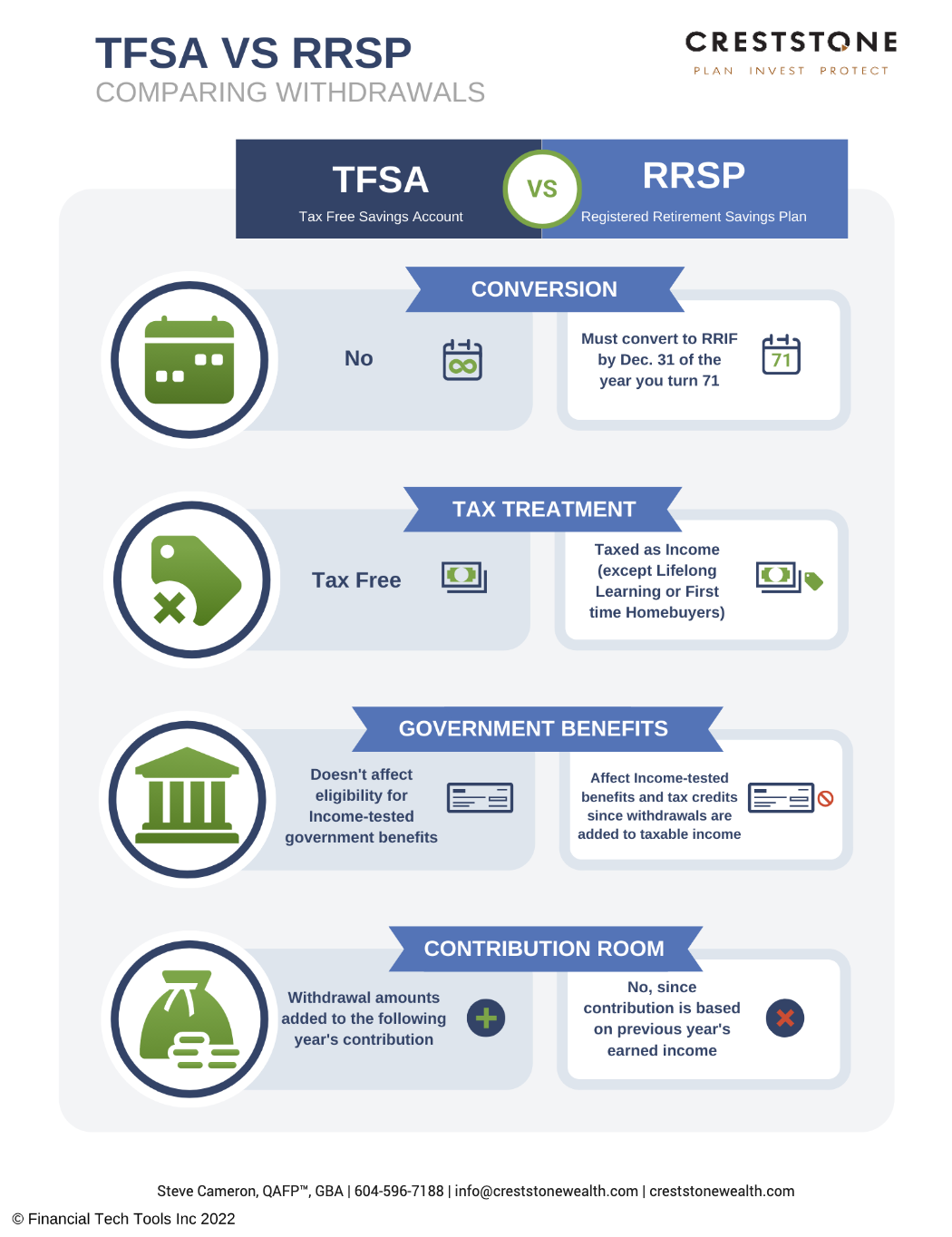
    For a TFSA, there are never any conversion requirements as there is no maximum age for a TFSA. However, if you have an RRSP, you must convert it to a Registered Retirement Income Fund (RRIF) if you turn 71 by December 31st of 2022.

    Tax Treatment Of Withdrawals

    One of the most attractive things about a TFSA is that all your withdrawals are tax-free! This ability to withdraw funds tax-free is why TFSAs are advantageous for short-term goals; you don’t have to worry about taxes when you take money out to pay for a house or a dream vacation.

    With an RRSP, if you make a withdrawal before converting it to a RRIF, it will be taxed as income except in two cases:

    1. The Home Buyers Plan lets you withdraw up to $35,000 tax-free, but you must pay it back within fifteen years.

    2. The Lifelong Learning Plan lets you withdraw up to $20,000 ($10,000 maximum per year) tax-free, but you must pay it back within ten years.

    How will my government benefits be impacted?

    If you are withdrawing from your TFSA or RRSP, it is essential to know how your withdrawals can impact any benefits you receive from the government.

    Since TFSA withdrawals are not considered taxable income, they will not impact your eligibility for income-tested government benefits.

    RRSP withdrawals are considered taxable income and can affect the following:

    • Income-tested tax credits such as Canada Child Tax Benefit, the Working Income Tax Benefit, the Goods and Services Tax Credit, and the Age Credit.

    • Government benefits including Old Age Security, Guaranteed Income Supplement and Employment Insurance.

    How will a withdrawal impact my contribution room?

    If you make a withdrawal from your TFSA, then the amount you withdrew will be added on top of your annual contribution room for the following calendar year. However, if you withdraw money from your RRSP, you do not open up additional contribution room.

    The Takeaway

    RRSPs and TFSAs can both be great savings vehicles. With this in mind, understanding the differences between these two types of tax-advantaged accounts can help you better plan for future purchases and your eventual retirement.

    Share this entry
    • Share on Facebook
    • Share on X
    • Share on WhatsApp
    • Share on LinkedIn
    • Share by Mail
    https://creststonewealth.com/wp-content/uploads/2022/02/TFSA-vs-RRSP-2022.png 281 500 CRESTSTONE Wealth https://creststonewealth.com/wp-content/uploads/2021/05/creststone-logo-550.png CRESTSTONE Wealth2022-02-01 07:00:002022-02-01 18:46:55TFSA versus RRSP – What you need to know to make the most of them in 2022

    Search Blog Posts

    Search Search

    Newsletter

    Categories

    • 2021
    • 2022
    • 2022 Only
    • 2023
    • 2024
    • 2025
    • 2026
    • Accountants
    • Article
    • blog
    • Budget
    • Business Owners
    • business owners
    • Buy Sell
    • Center of Influences
    • Coronavirus
    • Coronavirus – Associates
    • Coronavirus – Practice Owners
    • Coronavirus – Students
    • corporate
    • Debt
    • dental benefits
    • disability
    • disability insurance
    • Estate Planning
    • Family
    • farmers
    • financial advice
    • financial planning
    • Government Budget
    • Group Benefits
    • health benefits
    • incorporated professionals
    • Individuals
    • Insurance
    • Investment
    • life insurance
    • mortgage
    • pension plan
    • Personal
    • personal finances
    • Professional Corporations
    • Professionals
    • RDSP
    • Registered Education Savings Plan
    • Retirees
    • Retirement
    • RRSP
    • tax
    • Tax Free Savings Account

    Tags

    beneficiary business business owners business succession children debt estate estate planning families funeral expenses individuals key person Life Insurance marital status Mortgage retirement smoking tax

    NEWS + SUPPORT

    Keep up to date with the latest news and helpful websites that share important information related to your business and personal financial needs.

    resources

    Federal Budget 2026: What the New Federal Measures Could Mean for Your Money

    November 10, 2026
    Budget 2026 proposes new affordability, housing, benefit, and business investment measures. From fuel tax relief and a groceries benefit supplement to an “RRSP for life” consultation and the Productivity Mega Deduction, here is a plain-language overview of what the November 5, 2026 budget could mean for Canadians’ money.
    Read more
    https://creststonewealth.com/wp-content/uploads/2026/11/federal-budget-2026-what-it-could-mean-featured.png 1080 1920 CRESTSTONE Wealth https://creststonewealth.com/wp-content/uploads/2021/05/creststone-logo-550.png CRESTSTONE Wealth2026-11-10 14:33:182026-11-10 14:33:59Federal Budget 2026: What the New Federal Measures Could Mean for Your Money

    The RDSP: A Long-Term Savings Tool Canadian Families and Individuals Should Know About

    September 2, 2026
    The federal government has contributed $5.1 billion in grants and $2.1 billion in bonds to Registered Disability Savings Plans since 2008 — yet only 23% of eligible Canadian children aged 0 to 18 have one. Here's how the RDSP works, how much the government match can add each year, why starting early matters, and what the latest 2024 data reveals about the families already benefiting.
    Read more
    https://creststonewealth.com/wp-content/uploads/2026/09/The-RDSP-A-Long-Term-Savings-Tool-Canadian-Families-and-Individuals-Should-Know-About.png 700 1200 CRESTSTONE Wealth https://creststonewealth.com/wp-content/uploads/2021/05/creststone-logo-550.png CRESTSTONE Wealth2026-09-02 21:55:002026-09-02 21:55:18The RDSP: A Long-Term Savings Tool Canadian Families and Individuals Should Know About

    Redesigning Group Benefits: Balancing Cost and Employee Value

    August 8, 2026
    As benefits advisors, we see employers struggling to balance rising costs with employee expectations for flexibility and support. This article explores what employees value most, the risks of cutting coverage, and how data-driven strategies can help organizations redesign plans that deliver both cost control and employee satisfaction.
    Read more
    https://creststonewealth.com/wp-content/uploads/2026/08/Redesigning-Group-Benefits-Balancing-Cost-and-Employee-Value.png 700 1200 CRESTSTONE Wealth https://creststonewealth.com/wp-content/uploads/2021/05/creststone-logo-550.png CRESTSTONE Wealth2026-08-08 08:00:382026-08-08 08:01:08Redesigning Group Benefits: Balancing Cost and Employee Value

    Surrey Office

    604-596-7188
    info@creststonewealth.com

    210 – 5455 152nd St
    Surrey, BC
    V3S 5A5

    KELOWNA OFFICE

    250-860-8389
    info@creststonewealth.com

    1100-1631 Dickson Ave
    Kelowna, BC
    V1Y 0B5

    ABOUT

    Creststone Wealth is a financial planning, investing + insurance firm located in British Columbia, serving clients across Canada.

    NEWSLETTER

    OUR DEALER

    IPC Wealth logo

    Insurance products, including segregated fund policies, are offered through Creststone Wealth by Financial Advisors Stephen Cameron, Noreen G. Winzoski, Rochelle Bates, Terry Sorensen, Bharpur Singh Gill and Lise Winzoski, and Financial Advisors Stephen Cameron, Noreen G. Winzoski, Rochelle Bates, Bharpur Singh Gill and Lise Winzoski offer mutual funds through IPC Wealth Inc. IPC Wealth Inc. is a member of CIRO and the Canadian Investor Protection Fund.

    IPC Wealth and design are trademarks of Investment Planning Counsel Inc. and used under license by IPC Wealth Inc.

    For the IPC Wealth privacy policy, click here.

    Make your investment decisions wisely. Important information about mutual funds is found in the Fund Facts document. Please read this carefully before investing. Commissions, trailing commissions, management fees and expenses all may be associated with mutual fund investments. Mutual funds are not guaranteed, their values change frequently and past performance may not be repeated. Unit values and investment returns will fluctuate.

    ©2021 Financial Tech Tools Inc. | Privacy Statement and Terms of Use
      Link to: 2022 Financial Calendar Link to: 2022 Financial Calendar 2022 Financial Calendar Link to: 2022 British Columbia Budget Highlights Link to: 2022 British Columbia Budget Highlights 2022 British Columbia Budget Highlights
      Scroll to top Scroll to top Scroll to top